

Kuehne+Nagel's 500,000 sqm India Footprint Signals MNC 3PLs' Bet on India Consumption
Kuehne+Nagel's strategic investment reflects mapping India as a vital domestic consumption market demanding sophisticated fulfilment infrastructure across multiple city tiers.
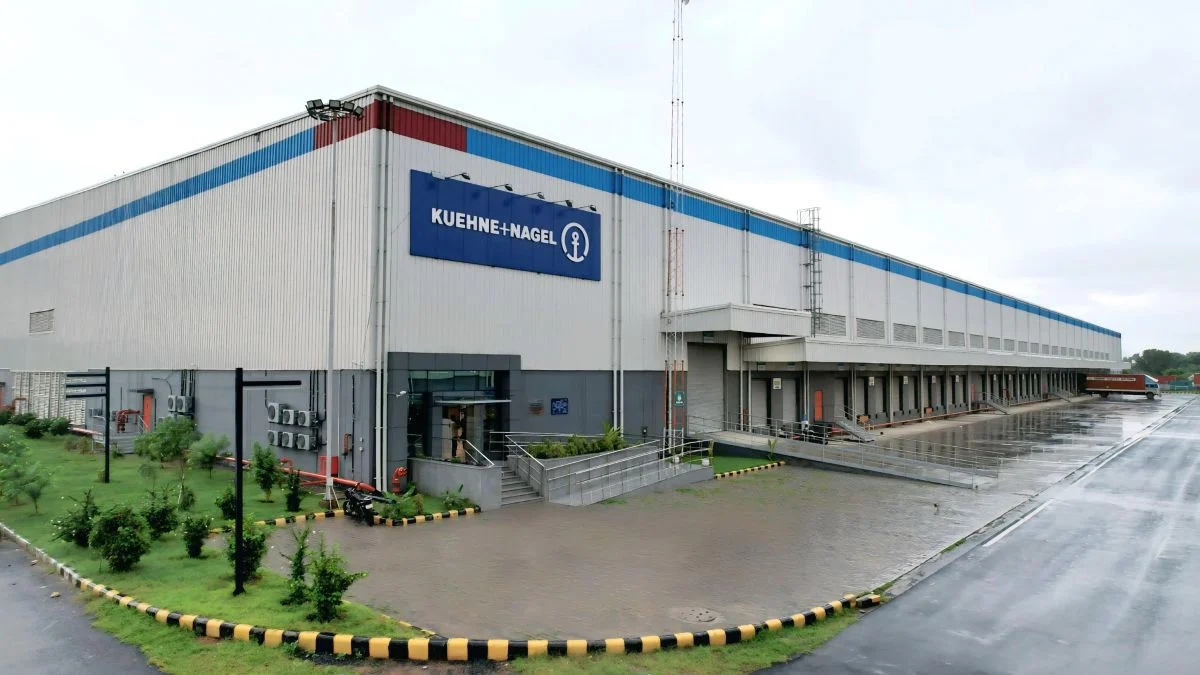

> Takeaways
• Kuehne+Nagel expands India footprint to 500,000 sqm, generating 1,500 new jobs.
• Multi-tier city strategy signals bet on domestic consumption over export logistics.
• Automation investment creates 75% peak capacity increase, addressing festival season demand surges.
• Tier-2/tier-3 expansion shows multi-node strategy for reaching dispersed Indian consumption markets.
• Capital-intensive automation targets high-volume customers, differentiating from labor-intensive domestic 3PLs.
Kuehne+Nagel, the Switzerland-headquartered global logistics provider with over 82,000 employees across nearly 1,300 sites in close to 100 countries, has announced a 100,000 square meter fulfilment center expansion across five Indian cities, a move that is likely to generate over 1,500 new jobs. The company has increased its total warehouse footprint in India to nearly 500,000 square meters, said the company in a press statement. As the world's leading air and sea freight forwarder and a top-tier contract logistics operator serving 400,000 customers globally, Kuehne+Nagel's strategic investment reflects mapping India as a vital domestic consumption market demanding sophisticated fulfilment infrastructure across multiple city tiers.
The expansion's geographic distribution, spanning tier-1 cities Mumbai and Kolkata, tier-2 hubs Gurgaon and Nagpur, and tier-3 Rajpura, reflects the multi-nodal urban growth pattern that distinguishes India's logistics landscape from China's historically coastal concentration. Unlike China where 3PL expansion followed manufacturing clusters in Guangdong and Yangtze River Delta regions serving export markets, Kuehne+Nagel's India strategy prioritizes proximity to consumer demand centers rather than export gateways. This positioning signals that the company anticipates India's logistics growth will be driven by e-commerce, healthcare distribution, and domestic consumer goods rather than the containerized export flows that traditionally generate the highest margins for international freight forwarders.
The Automation Strategy
The expansion's emphasis on automation technologies—including telescopic conveyors and high-performance sorting systems that enable a 75% increase in peak order handling capacity—suggests Kuehne+Nagel is designing for a future where labor cost advantages will inevitably reduce. A strategic calculus such as this differs markedly from the labor-intensive warehousing models that domestic Indian 3PLs like Allcargo Logistics and VRL Logistics have traditionally deployed, which rely on abundant low-cost manual handling to achieve competitive pricing.
By front-loading automation investment now, Kuehne+Nagel is creating operational cost structures that become more competitive as Indian wages rise, a trajectory that demographic and urbanization trends make inevitable over the next decade. The company's 75% peak capacity improvement through automation also addresses the extreme demand volatility that Indian e-commerce creates, particularly during festival seasons (Diwali, Dussehra) when order volumes can surge 300-400% above baseline for 4-6 week periods. Manual labor scaling to meet these peaks creates hiring, training and retention challenges that automation substantially reduces.
However, this automation-first approach requires minimum throughput volumes to justify capital expenditure, that would put pressure on Kuehne+Nagel to secure anchor customers with contracted volumes sufficient to achieve payback within acceptable timeframes. For smaller e-commerce brands or mid-market manufacturers evaluating 3PL partnerships, this implies Kuehne+Nagel's pricing will target high-volume customers where automation economics work, potentially ceding smaller accounts to domestic 3PLs with lower fixed cost structures.
Tier-2 and Tier-3 Expansion
Kuehne+Nagel's inclusion of Nagpur and Rajpura alongside traditional metro markets Mumbai, Kolkata, and Gurgaon reflects sophisticated understanding of India's distribution challenges. Unlike logistics networks in the United States or Europe where 80-90% of population and consumption concentrate in 20-30 major metros, India's consumption is dispersed across hundreds of cities with populations between 100,000-1 million. Reaching these markets cost-effectively requires forward-deployed inventory in tier-2 and tier-3 locations rather than hub-and-spoke distribution from tier-1 cities.
Nagpur's selection is particularly strategic. The city sits at India's geographic center, providing roughly equidistant access to all four corners of the country and positioning it as an ideal national distribution hub for sectors requiring pan-India reach with minimized transit times. Major automotive manufacturers including Tata Motors and Mahindra have established assembly operations in the Nagpur region, creating both manufacturing logistics demand and a skilled workforce pool that reduces Kuehne+Nagel's training costs.
Image courtesy: Kuehne+Nagel Newsroom
Rajpura, located in Punjab state between Delhi and Amritsar, represents a more futuristic bet. As a tier-3 city, Rajpura lacks the industrial density of established logistics hubs, but its position on the Amritsar-Kolkata Industrial Corridor (AKIC) and proximity to northern manufacturing clusters in Baddi and Chandigarh creates potential as a forward stocking location for fast-moving consumer goods (FMCG) targeting Punjab, Haryana, and Himachal Pradesh markets. The fact that Kuehne+Nagel is willing to invest in tier-3 locations suggests the company sees sufficient demand density to justify dedicated infrastructure even outside India's top 20 urban centers.
For supply chain professionals designing India distribution networks, Kuehne+Nagel's tier-2/tier-3 expansion validates the multi-node strategy that reduces last-mile delivery costs and transit times but increases inventory carrying costs and network complexity.