

Maersk's Battery Partnership with CATL Bodes Well for Shipping's Decarbonization
The collaboration includes exploring electrification across container shipping and port systems, supported by battery recycling and energy management frameworks.
Takeaways
• Maersk partners with CATL to electrify ocean, port, and warehouse operations.
• Partnership addresses carbon exposure from 549 warehouses and delivery fleets globally.
• CATL becomes a partner for global logistics decarbonization efforts.
• Strategy bets on battery technology advancing to support operational scale requirements.
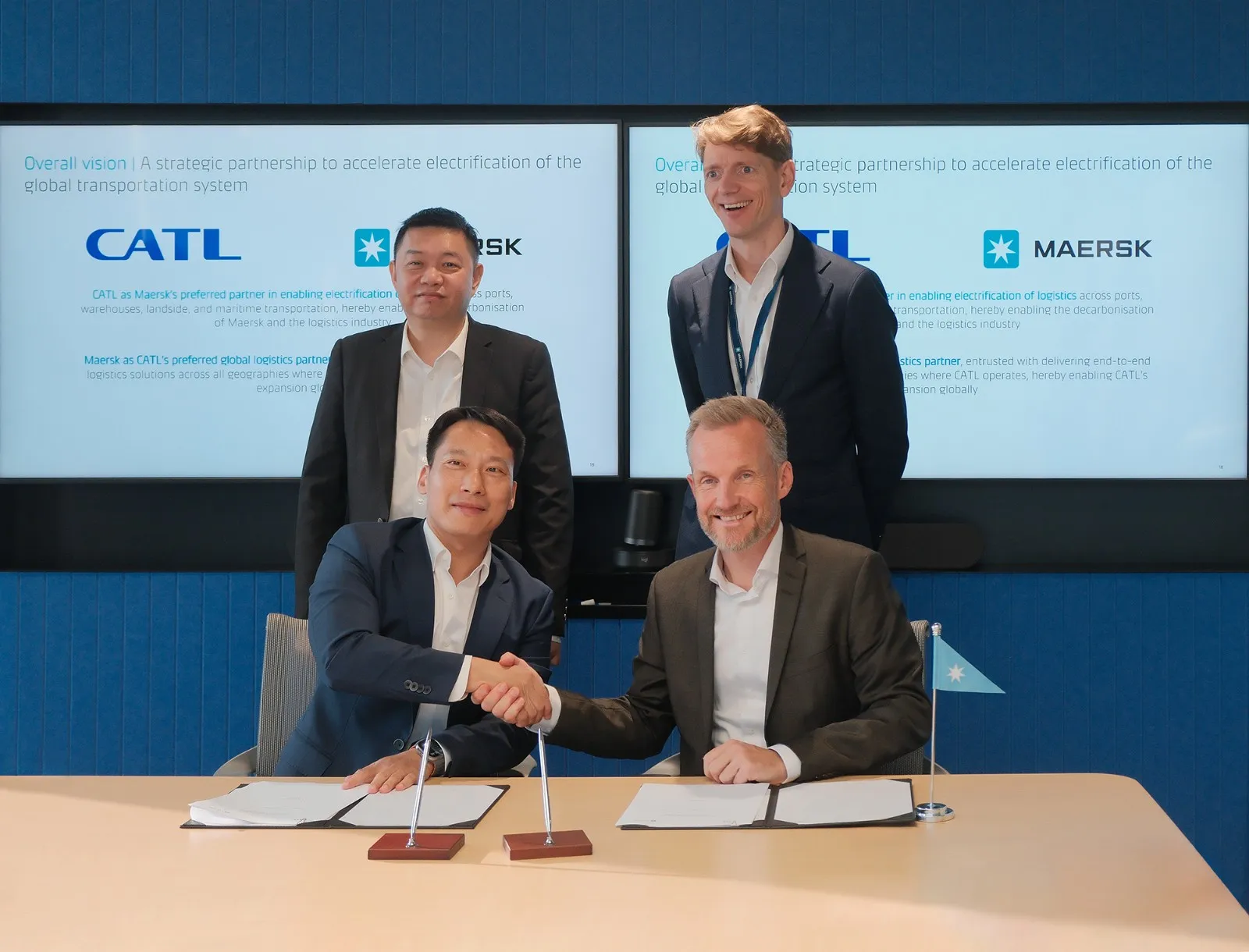
Maersk, the integrated shipping and logistics behemoth, has formalized collaboration with CATL (Contemporary Amperex Technology Co., Limited), a Chinese battery tech company and a global leader in battery technology innovation, to explore ways of transitioning supply chain nodes toward electric power, with focus areas including ocean container systems, port infrastructure, road-based movement, and warehouse operations. This partnership signals how legacy shipping giants are solving their climate commitments.
CATL, a Chinese battery manufacturer founded in 2011, has become the world's largest EV and energy storage battery producer, commanding around 38% global market share in EV batteries and 36.5% in energy storage systems per latest estimates. By choosing CATL as preferred battery technology partner, Maersk is explicitly betting on Chinese battery leadership to underpin its decarbonization strategy.
Maersk has updated its decarbonization target: it aims for net-zero greenhouse gas output across all operations by 2040. For a company moving millions of containers annually powered by fuel-intensive vessels, achieving that requires fundamental operational redesign. The collaboration includes exploring electrification across container shipping and port systems, supported by battery recycling and energy management frameworks. It means that Maersk isn't buying green credits; it's architecting infrastructure to run on different fuel sources.
Maersk and CATL Teams Sign Deal. Credit: Maersk Corporate
Maersk’s Integrated Logistics Strategy

Here's the business context most coverage misses: Maersk spent the last five years making a radical pivot from pure container shipping toward end-to-end logistics coverage. The company completed a $3.6 billion acquisition of a Hong Kong-based contract logistics firm, LF Logistics, adding 223 warehouses and bringing total global facilities to 549 across 9.5 million square meters. That warehouse footprint, added systematically through acquisitions in Asia, North America, and Europe, isn't about warehousing efficiency alone.
Maersk has progressively acquired business-to-consumer logistics expertise in the U.S. for e-commerce fulfillment, parcel injection and last-mile delivery across the EU, air forwarding capabilities, and deepened Asia-Pacific coverage through major acquisitions, positioning itself to offer integrated door-to-door solutions. These weren't small tuck-in deals. A $1.68 billion acquisition of Pilot Freight Services, a full-service transportation and logistics provider with 87 North American stations added capabilities in big and bulky e-commerce delivery and cross-border logistics.
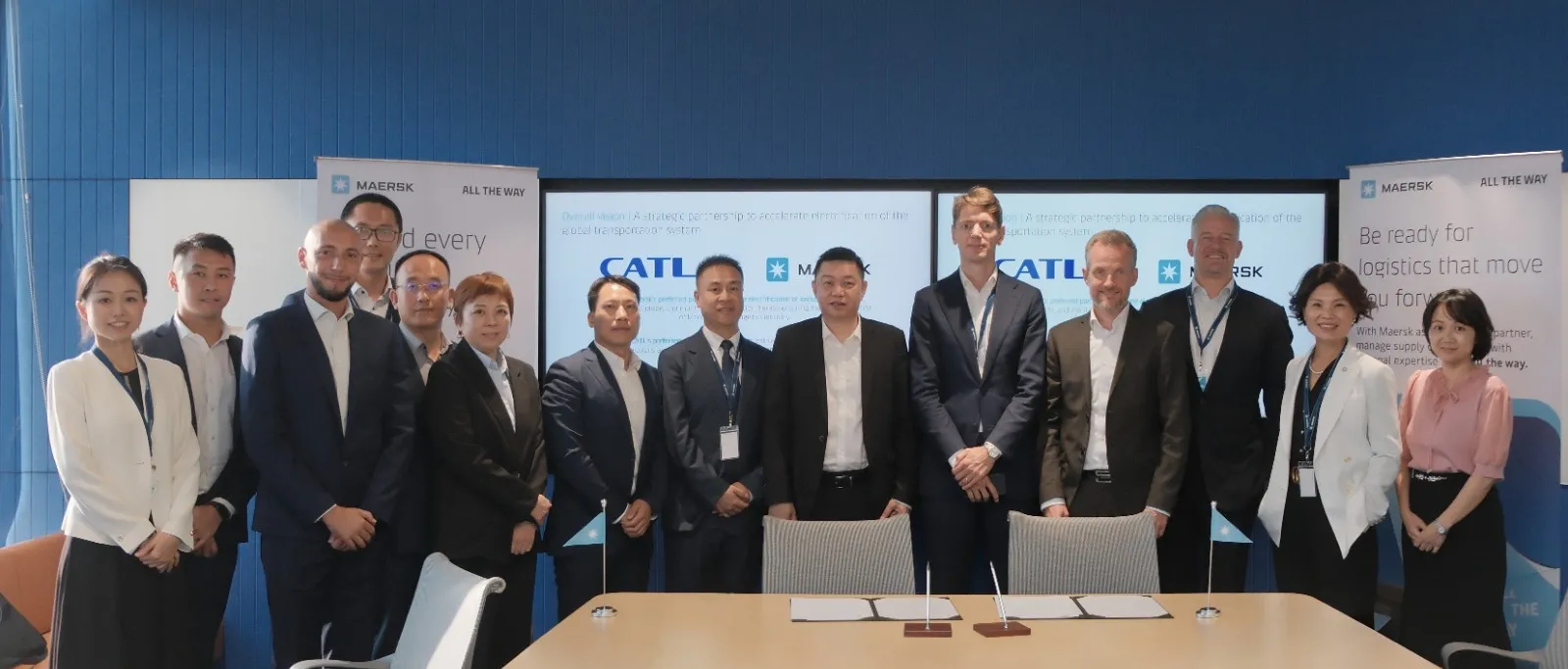 Maersk-CATL Team. Credit: Maersk Corporate
The pattern is unmistakable: Maersk transformed from shipping company into logistics integrator. But that strategy carried an uncomfortable problem—as the company expanded into warehousing, fulfillment, and last-mile delivery, it inherited new carbon exposure points. A company owning 549 warehouses and managing thousands of delivery vehicles globally cannot credibly target net-zero by 2040 without electrifying those assets. Traditional efficiency gains don't close that gap.
Why CATL
Under the expanded partnership framework, CATL will function as the preferred technology partner supporting Maersk's emissions roadmap. It represents a strategic choice to depend on Chinese battery innovation at scale. CATL operates manufacturing capacity across multiple countries and is recognized as a leader in lithium iron phosphate battery technology, having established partnerships with major European and North American vehicle manufacturers and launched carbon-neutral production facilities in China with zero-carbon certification. By positioning CATL as preferred partner, Maersk gains access to proven, scaled battery architectures and manufacturing expertise while publicly validating Chinese battery technology as essential to global logistics decarbonization.
The partnership creates mutual benefit: Maersk gains access to advancing battery systems and integration support for its operations; CATL gains validation from a multinational with carbon commitments backed by operational scale and regulatory scrutiny. The partnership also formalizes Maersk as CATL's global logistics provider, handling ocean freight, air cargo, project logistics and warehousing across markets.
Reconciling Scale with Climate Targets
Maersk operates one of the world's largest logistics networks, spanning ocean vessels burning heavy fuel oil, thousands of delivery vehicles, and hundreds of warehouse facilities consuming grid power. Electrifying ports and warehouses is operationally tractable. Electric vehicle fleets for parcel delivery are already deployed globally. The harder problem is container vessels and long-haul trucking, where electrification remains nascent. By partnering with CATL on battery systems while publicly committing to 2040 net-zero, Maersk is essentially betting that battery technology and renewable grid capacity will advance sufficiently to support its operational scale within 15 years.