

Port of Gauteng's R50 Billion Inland Port Affirms SA’s Logistics Bid
Port of Gauteng releases White Paper detailing R50 billion inland port plan to address South Africa's freight challenge, affecting 50,000 jobs and rail modal shift as 2030 deadline approaches.
Port of Gauteng's R50 Billion Inland Port Affirms SA’s Logistics Bid
Port of Gauteng releases White Paper detailing R50 billion inland port plan to address South Africa's freight challenge, affecting 50,000 jobs and rail modal shift as 2030 deadline approaches.
Takeaways
• Port of Gauteng releases White Paper detailing R50 billion private > infrastructure initiative.
• Project targets 50,000 jobs while addressing South Africa's rail freight crisis urgently.
• E-commerce growth from Shein, Temu, Amazon strains existing Durban-Gauteng corridor capacity.
• PBS vehicle integration cuts truck movements 40% while improving road safety.
• Private intervention aims to restore rail competitiveness before 2030 NDP deadline.
Port of Gauteng, a private sector-led R50 billion inland logistics hub development covering 1,400 hectares in South Africa's Gauteng Province, has released a White Paper outlining plans to address what has become an existential crisis for the country's freight transport system. Led by NT55 Investments, a port investor, alongside over 100 property owners, the project represents one of South Africa's largest private infrastructure initiatives and proposes to create 50,000 permanent jobs while influencing how freight moves along the critical Durban-Gauteng corridor that serves as the economic artery for sub-Saharan Africa's most industrialized region.

The release of this White Paper at the commencement of Transport Month observed every October in South Africa, brings into focus the country’s National Development Plan's 2030 targets. The country's rail system currently moves less than 14% of freight volumes along the Durban-Gauteng corridor, substantially missing the NDP's 50% modal shift target. Meanwhile, Transnet, the state-owned rail and port operator stares at a R50 billion infrastructure backlog with its debt projected to reach R151 billion this year. Port of Gauteng's proposal essentially argues that without private sector intervention to create rail-competitive infrastructure, South Africa's logistics costs will continue constraining economic growth while road infrastructure deteriorates under unsustainable truck traffic.
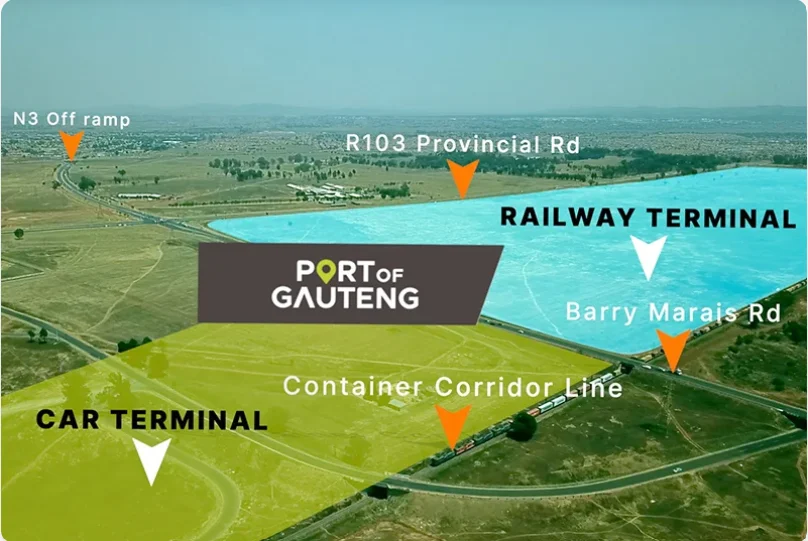
Image courtesy: Port of Guateng Website
E-Commerce Growth Demands Improved Infrastructure
The White Paper's emphasis on e-commerce giants Shein, Temu, and Amazon entering the South African market reveals a critical aspect about the country's logistics system that extends beyond traditional freight considerations. These platforms are driving South Africa's economy toward a high-volume, lower-margin model that will inevitably shift from air freight to container shipping as volumes scale, placing additional pressure on the Durban-Gauteng corridor.
For supply chain professionals managing South African distribution networks, the surge in e-commerce volume presents immediate challenges and long-term payoffs. Companies relying on just-in-time delivery models face growing inventory carrying costs as buffer stock requirements increase to compensate for logistics unreliability.
The Port of Gauteng's integration of Performance-Based Standards (PBS) vehicles —long truck-trailer combinations capable of carrying two containers —represents perhaps the most strategically significant element of the proposal beyond rail infrastructure itself. The port article quoted Dr. Paul Nordengen, Director at Heavy Vehicle Transport Technology Africa, emphasizing that PBS vehicles can cut truck movements by as much as 40% and also boost road safety thanks to better vehicle stability.
The innovation here isn't the PBS technology itself—Australia has successfully deployed similar systems for decades—but rather how Port of Gauteng is positioning PBS adoption as the enabler for making rail commercially viable in South Africa's specific context. The facility's purpose-built rail alignments with projected three-hour turnaround times only deliver competitive advantage if the final-mile distribution from the inland port to end customers operates efficiently. PBS vehicles provide that efficiency by doubling container capacity per truck movement, dramatically reducing the cost penalty of the additional handling step that inland ports inherently introduce compared to direct port-to-customer delivery.